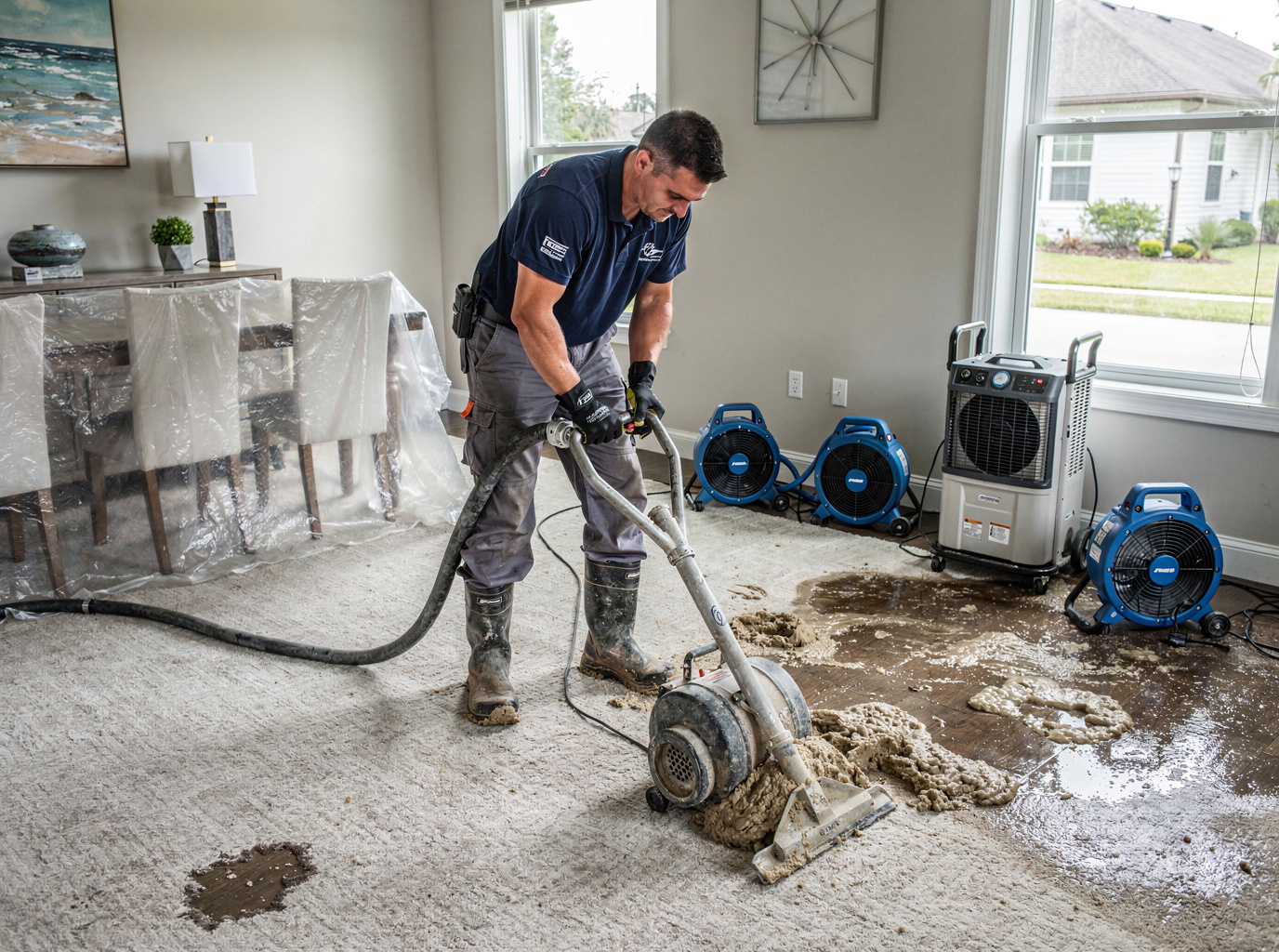
Jacksonville’s humid subtropical weather keeps relative humidity high most of the year, so standing water in a Riverside or Springfield crawlspace can quickly turn into hidden mold growth behind plaster and under original heart-pine floors. Older homes in these neighborhoods often have balloon-frame construction and limited access points, which means crews must cut strategic openings rather than rely on surface drying alone. Properties near the St. Johns River or in low-lying parts of Mandarin and Avondale also face tidal surge and stormwater backup that saturates slab edges and foundation walls.
Technicians begin with moisture mapping using pin and pinless meters plus infrared cameras to locate water that has wicked into drywall, insulation, and subfloors. In Arlington and San Marco homes built on fill dirt, capillary action can pull moisture several feet up masonry walls, requiring targeted demolition and negative-air drying setups. Once water is extracted, industrial dehumidifiers and air movers run for days rather than hours because the coastal air rarely drops below 60 percent humidity even in mild winters.
Final verification includes post-drying moisture readings below 12 percent on wood and 0.5 percent on concrete before any reconstruction begins. Homeowners in Downtown Jacksonville and near EverBank Field frequently request documentation for insurance claims after heavy summer thunderstorms or nor’easters that overwhelm aging storm drains.
Technician insight
In Jacksonville the thing that catches most people out with water damage restoration is how fast the high humidity re-wets materials once the equipment is pulled too early. Homes in Riverside and near the St. Johns River often have older balloon framing that hides moisture pockets you won’t find without infrared, and if you don’t run the dehumidifiers long enough the job comes back in two weeks.
Crawlspace Flood After Summer Storm
Water backed up through a clogged French drain in an Arlington home built on fill dirt. Infrared scans showed moisture had wicked into floor joists and subflooring. Extraction and targeted drying ran for five days before readings allowed new insulation and vapor barrier installation.
Water Damage Restoration Service Services We Offer
✓Emergency Water Extraction
Rapid removal of standing water from kitchens, bathrooms, and basements using truck-mounted pumps to prevent further saturation of subfloors in Jacksonville homes.
✓Structural Drying and Dehumidification
Placement of commercial air movers and dehumidifiers to pull moisture from walls, ceilings, and crawlspaces common in Riverside and Springfield properties.
✓Mold Remediation After Water Damage
Containment, removal, and antimicrobial treatment of mold that develops quickly in Duval County’s humid climate following leaks or flooding.
✓Drywall and Insulation Replacement
Cutting out and replacing water-soaked drywall and insulation in San Marco and Avondale homes while preserving original trim where possible.
✓Carpet and Hardwood Floor Restoration
Cleaning, drying, and refinishing hardwood floors or salvaging carpet padding in Mandarin and Arlington residences after clean-water incidents.
✓Storm and Flood Damage Repair
Board-up, debris removal, and drying services for homes near the St. Johns River or in Orange Park after heavy rain or tropical systems.
Water Damage Restoration Service Cost in Jacksonville, FL
| Service | Typical Range | What Affects It |
|---|---|---|
| Category 1 Water Extraction | $400–$900 | Clean water from supply lines; price rises with multiple rooms or second-story access. |
| Category 2–3 Drying Package | $1,200–$2,800 | Includes equipment rental and daily checks for gray or black water events common near the river. |
| Drywall Removal And Replacement | $2.50–$4.50 per sq ft | Labor and materials; higher in older Springfield homes with plaster over lath. |
| Crawlspace Drying | $600–$1,400 | Equipment and labor for low-access spaces typical in Mandarin and Avondale. |
Ranges are typical for Jacksonville, FL and confirmed with an exact written quote before any work starts.
How it works
- 1
Initial Assessment
Technician arrives at the Jacksonville property, documents affected areas in neighborhoods like Riverside or Arlington, and uses moisture meters to map water migration.
- 2
Water Removal
Standing water is extracted with pumps and wands, then salvageable contents are moved while protecting unaffected rooms.
- 3
Drying And Monitoring
Equipment runs continuously with daily moisture checks until readings reach safe levels for reconstruction.
- 4
Restoration And Verification
Damaged materials are replaced, final drying is confirmed, and the site is returned to pre-loss condition.
Pricing
Pricing varies by water category, affected square footage, and how long drying takes in Jacksonville’s humid air.